
# load in necessary libraries
library(tidyverse)
library(png)
library(ggtext)
library(sf)
library(tmap)
library(cowplot) # to layer tmap and ggplot
library(ggplotify)
library(ggspatial)

# read in data
bats <- read_csv(here::here("data", "figshare-bat-data", "Dataset_1.csv")) |>
  janitor::clean_names()

#...................POPULATION TRENDS BARPLOTS...............

# calculate population trend values
pop_status_df <- bats |>
  summarise(.by = c(population_status, extinction_risk), value = n()) |>
  arrange(value) |>
  ungroup()

# set a population trends color palette
ext_pal <- c("Decreasing" = "#FFA545",
                 "Unknown" = "white",
                 "Stable" = "#A4B1F9",
             "Increasing" = "#DFFAA5")

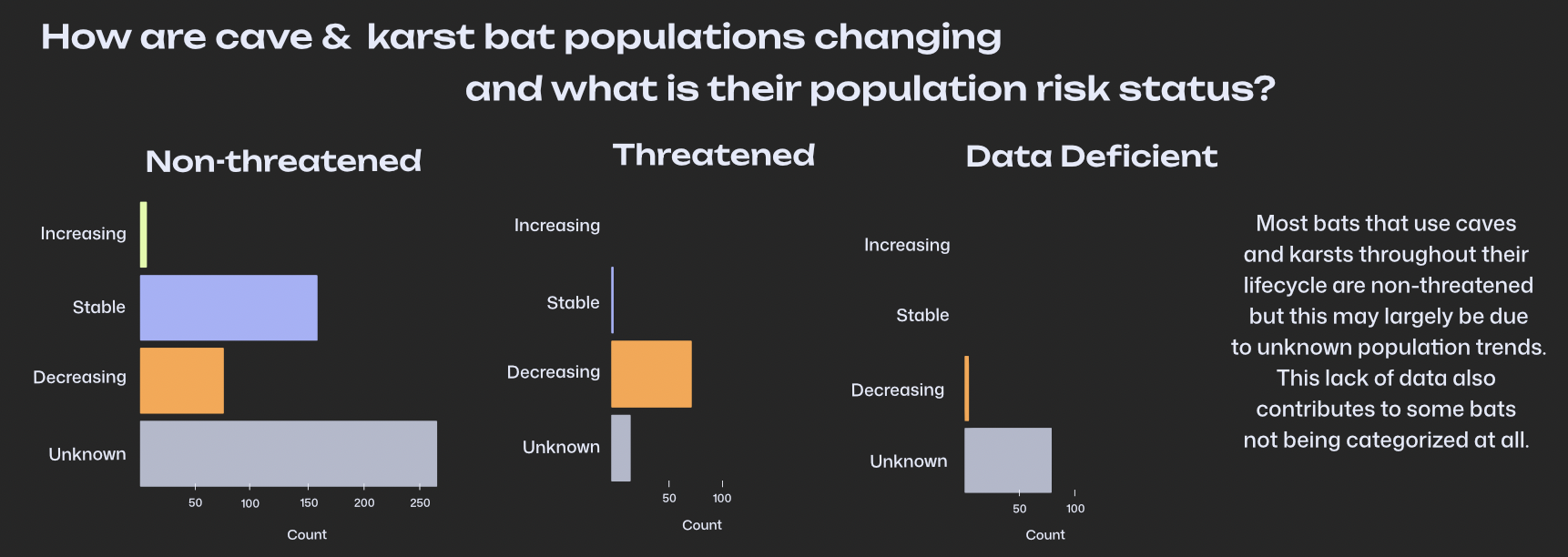
# threatened bat species barplots
threatened_bp <- pop_status_df |>
  filter(extinction_risk == "Threatened") |>
   arrange(factor(population_status, c("Increasing",
                                       "Stable",
                                       "Decreasing",
                                       "Unknown"))) |>
  mutate(population_status = fct_relevel(population_status,
                                         "Unknown",
                                         "Decreasing",
                                         "Stable",
                                         "Increasing")) |>
  ggplot() +
  geom_col(aes(x = value,
               y = population_status,
               fill = population_status)) +
  # facet_wrap(~extinction_risk, nrow = 3) +
  theme_minimal() +
  scale_fill_manual(values = ext_pal) +
  theme(axis.title.y = element_blank(),
        axis.title.x = element_blank(),
        legend.position = "none",
        panel.background = element_rect(
        color = "transparent",
        fill = "transparent"
      ),
      plot.background = element_rect(
        color = "transparent",
        fill = "transparent"
      ),
      panel.grid = element_blank()
      ) +
  scale_x_continuous(
    limits = c(0, 275),                 # Set y-axis range from 10 to 35
    breaks = c(25, 50, 75, 100, 125, 150, 175, 200, 225, 250, 275) # Specify custom tick locations
  )

# non-threatened bat species barplot
nonthreatened_bp <- pop_status_df |>
  filter(extinction_risk == "Non threatened") |>
  arrange(factor(population_status, c("Increasing",
                                       "Stable",
                                       "Decreasing",
                                       "Unknown"))) |>
  mutate(population_status = fct_relevel(population_status,
                                         "Unknown",
                                         "Decreasing",
                                         "Stable",
                                         "Increasing")) |>
  ggplot() +
  geom_col(aes(x = value,
               y = population_status,
               fill = population_status)) +
  theme_minimal() +
  scale_fill_manual(values = ext_pal) +
  theme(axis.title.y  = element_blank(),
        axis.title.x = element_blank(),
        legend.position = "none",
        panel.background = element_rect(
        color = "transparent",
        fill = "transparent"
      ),
      plot.background = element_rect(
        color = "transparent",
        fill = "transparent"
      ),
      panel.grid = element_blank())+
  scale_x_continuous(
    limits = c(0, 275),                 # Set y-axis range from 10 to 35
    breaks = c(25, 50, 75, 100, 125, 150, 175, 200, 225, 250, 275) # Specify custom tick locations
  )

# data deficient bat species barplot
data_deficient_bp <- pop_status_df |>
  filter(extinction_risk == "Data Deficient") |>
  arrange(factor(population_status, c("Increasing",
                                       "Stable",
                                       "Decreasing",
                                       "Unknown"))) |>
  mutate(population_status = fct_relevel(population_status,
                                         "Unknown",
                                         "Decreasing",
                                         "Stable",
                                         "Increasing")) |>
  ggplot() +
  geom_col(aes(x = value,
               y = population_status,
               fill = population_status)) +
  theme_minimal() +
  scale_fill_manual(values = ext_pal) +
  theme(axis.title.x = element_blank(),
        axis.title.y = element_blank(),
        legend.position = "none",
        panel.background = element_rect(
        color = "transparent",
        fill = "transparent"
      ),
      plot.background = element_rect(
        color = "transparent",
        fill = "transparent"
      ),
      panel.grid = element_blank()) +
  scale_x_continuous(
    limits = c(0, 275),                 # Set y-axis range from 10 to 35
    breaks = c(25, 50, 75, 100, 125, 150, 175, 200, 225, 250, 275) # Specify custom tick locations
  )

#...................BAT ECOSYSTEM OBSERVATIONS ...............

# convert the dummy variables into one tidy column
ecosystem_bats <- bats |>
  select(species_name, forest, savanna, dessert, urban, cave, wetlands) |>
  mutate(forest = case_when(forest == 1 ~ "forest",
                            forest == 0 ~ NA)) |>
  mutate(savanna = case_when(savanna == 1 ~ "savanna",
                              savanna == 0 ~ NA)) |>
  mutate(desert = case_when(dessert == 1 ~ "desert",
                            dessert == 0 ~ NA))  |>
  mutate(urban = case_when(urban == 1 ~ "urban",
                           urban == 0 ~ NA)) |>
  mutate(cave = case_when(cave == 1 ~ "cave",
                          cave == 0 ~ NA)) |>
  mutate(wetlands = case_when(wetlands == 1 ~ "wetland",
                              wetlands == 0 ~ NA)) |>
  pivot_longer(cols = c(forest, savanna, desert, urban, cave, wetlands),
               names_to = "ecosystem_type",
               values_to = "ecosystem") |>
  filter(!is.na(ecosystem)) |>
  select(species_name, ecosystem)

# calculate the number of bats in each ecosystem
ecosystem_bat_values <- ecosystem_bats |>
  group_by(ecosystem) |>
  summarise(value = n()) |>
  arrange(value) |>
  ungroup()

# add an extra row for spacing
ecosystem_bat_values <- add_row(ecosystem_bat_values,
                                ecosystem = "clear",
                                value = 700 )

# set an ecosystem color palette
ecosystem_pal <- c("clear" = "#15161A", # use background color of visual
                   "forest" = "#A1BD93",
                   "savanna" = "#FAE7AE",
                   "desert" = "#E8A1A1",
                   "urban" = "#E5EAFA",
                   "cave" = "#E4B9C8",
                   "wetland" = "#74B2BC")

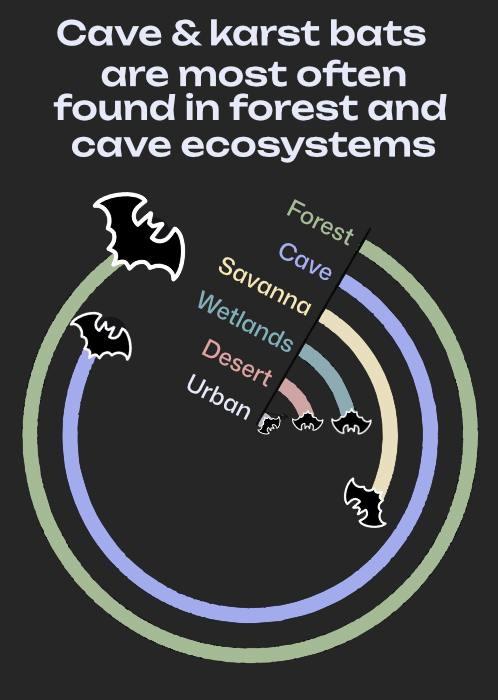
# construct the ecosystem graphic
ecosystem_bat_plot <- ecosystem_bat_values |>
  arrange(value) |>  # maintain the order of high to low ecosystem use
ggplot(aes(x= fct_inorder(ecosystem),
           y = value + 50,
           color = ecosystem,
           fill = ecosystem)) +
  ggforce::geom_link(aes(x = ecosystem,  # create the lines
                         xend = ecosystem,
                         y = 0,
                         yend = value + 50,
                         color = ecosystem,
                         color = after_scale(colorspace::desaturate(color, .3))),
                     n = 30,
                     size = 5) +
    ggpattern::geom_tile_pattern(fill = "transparent" # add the bats
                                 # pattern = "image",
                                 # pattern_filename = here::here("data", "noun-bat-8134648.png")
                                 ) +
#  geom_text(aes(label = value)) +
   annotate(geom = "segment",
            x = 0.8, xend = 6.5,
             y = 1, yend = 1,
            linewidth = 0.6) +
  scale_color_manual(values = ecosystem_pal) +
  coord_polar(theta = "y",
              start = 7,
             clip = "off"
              ) + # turn this plot circular
  theme_minimal() +
  theme(panel.grid.major.y = element_blank(),
        panel.grid.major.x = element_blank(),
        panel.grid.minor.x = element_blank(),
        panel.grid.minor.y = element_blank(),
        axis.title.x = element_blank(),
        axis.text = element_blank(),
        panel.background = element_rect(
        color = "transparent",
        fill = "transparent"),
        plot.background = element_rect(
         color = "transparent",
         fill = "transparent"),
        legend.position = "none") +
  labs(x = "")

#......................MAP AND DISTRIBUTION PLOTS.....................

# read in geospatial data sets
cave_bats <- read_csv(here::here("data", "figshare-bat-data", "Dataset_2.csv")) |>
  janitor::clean_names() |>
  rename(latitude = lattitude)

landscape_vul <- read_csv(here::here("data", "figshare-bat-data", "Dataset_3.csv")) |>
  janitor::clean_names()

# convert the longitude and latitude data to mappable geometry
geo_cave_bats <- st_as_sf(cave_bats, coords = c("longitude", "latitude"), crs = st_crs(4326))
geo_landscape_vul <- st_as_sf(landscape_vul, coords = c("longitude", "latitude"), crs = st_crs(4326))

# convert to a geographic crs
geo_cave_bats <- st_transform(geo_cave_bats, 3857)
geo_landscape_vul <- st_transform(geo_landscape_vul, 3857)

# map the data
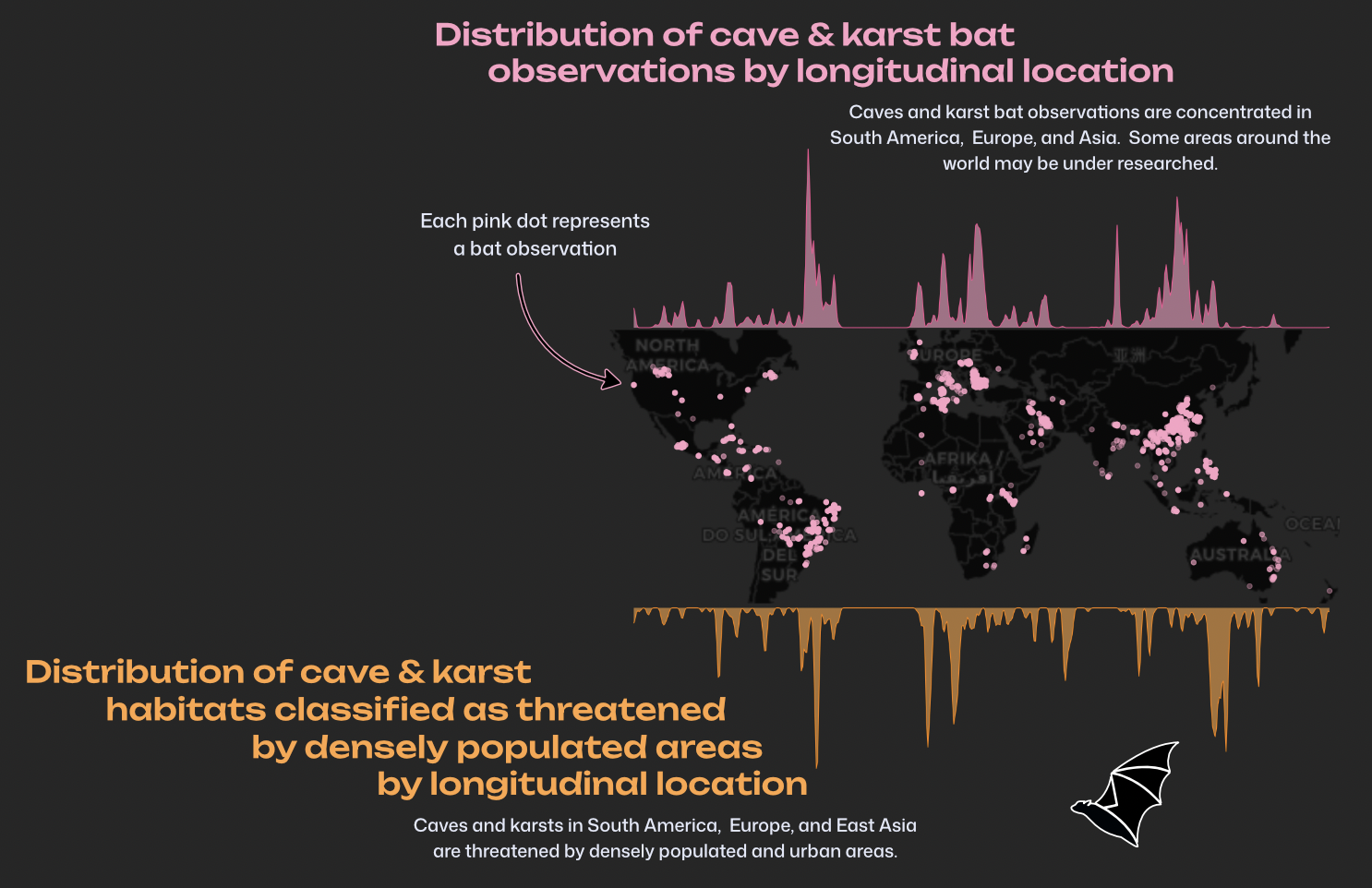
ggplot_map <- ggplot(geo_cave_bats) +
  ggspatial::annotation_map_tile(type = "cartodark") + # higher zoom values are more detailed
  geom_sf(aes(),
          color = "#FBA2C6",
          alpha = 0.4) +
  theme_minimal() +
  theme(panel.grid = element_blank(),
        axis.text = element_blank(),
        plot.margin = margin(0, 0, 0, 0))

# distribution plot of bat observations
dist_cave_bats <-
  cave_bats |>
  ggplot(aes(longitude)) +
    geom_density(
      color = colorspace::darken("#FBA2C6", .2, space ="HLS"),
      fill = "#FBA2C6",
      alpha = .6,
      size = .3,
      bw = .5
    ) +
  theme(
      panel.background = element_rect(
        color = "transparent",
        fill = "transparent"
      ),
      plot.background = element_rect(
        color = "transparent",
        fill = "transparent"
      ),
      plot.margin = margin(b = -1.4, t = 1.6),
      axis.title = element_blank(),
      axis.text = element_blank(),
      axis.ticks = element_blank(),
      panel.grid = element_blank()
    )

# filter the data for cave and karsts vulnerable to high populations and urban areas
pop_vul_caves <- landscape_vul |>
  filter(urban_dist < 1001 | pop_dens > 500)

# distribution plot of cave and karsts vulnerable to high populations and urban areas
dist_pop_vul <-  pop_vul_caves |>
  ggplot(aes(longitude)) +
    geom_density(
      color = colorspace::darken("#FFA545", .2, space ="HLS"),
      fill = "#FFA545",
      alpha = .6,
      size = .3,
      bw = .5
    ) +
    # scale_x_continuous(
    #   expand = c(.01, .01),
    #   limits = c(-200, 200)
    # ) +
  theme(
      panel.background = element_rect(
        color = "transparent",
        fill = "transparent"
      ),
      plot.background = element_rect(
        color = "transparent",
        fill = "transparent"
      ),
      plot.margin = margin(b = -1.4, t = 1.6),
      axis.title = element_blank(),
      axis.text = element_blank(),
      axis.ticks = element_blank(),
      panel.grid = element_blank()
    ) +
  scale_y_reverse()

# arrange the distribution plots and map
bat_distribution <-
  ggdraw(ggplot_map) +
  draw_plot(dist_cave_bats,
            x =  0,
            y = .701,
            width = 1,
            height = .3
            ) +
  draw_plot(dist_pop_vul,
            x = 0,
            y = 0.03,
            width = 1,
            height = .27
            )